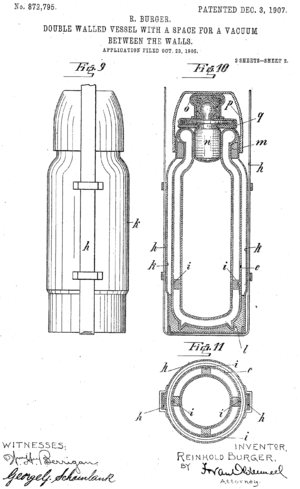

Vacuum flask (or Dewar flask or Thermos) has the remarkable capacity to hold extremely cold liquids like liquid nitrogen for a considerable length of time. The boiling point of liquid nitrogen is 77K compared to a room temperature of about 300K. You can hold liquid nitrogen for about a day without even a cover on the flask. The flask is able to effectively block heat transfer from the outside either through the walls or through the open top.
Vacuum flask – an insulating storage vessel that greatly lengthens the time over which its contents remain hotter or cooler than the flask’s surroundings. Invented by Sir James Dewar in 1892, the vacuum flask consists of two flasks, placed one within the other and joined at the neck. The gap between the two flasks is partially evacuated of air, creating a near-vacuum which prevents heat transfer by conduction or convection.
What’s the problem?
“How does it know whether to keep stuff hot or cold?” Where’s the switch? How does a Thermos (vacuum flask) work?
- Ask – It is nice to make a hot meal before leaving home and eat it later in the day. How can a container of hot food stay hot without an additional heat source? How does the same container keep something cold the next day?
- Imagine – How can heat transfer be blocked or slowed down?
- Design, Build – How can a vacuum be enclosed? What are other design considerations for a container to carry food?
- Improve – What modern materials can be used to replace glass as the container?
That’s engineering
- heat transfer – transfer of heat is normally from a high temperature object to a lower temperature object. Heat transfer changes the internal energy of both systems involved according to the First Law of Thermodynamics.
Engineering ideas
- heat transfer, vacuum, conduction, radiation, convection, First Law of Thermodynamics
Do It
Challenges for you to work on…
- design a new container to make use of the vacuum flask concept.
News, updates
Learn more…
- Vacuum flask – Wikipedia
- How Thermoses work

 engineering 4 kids